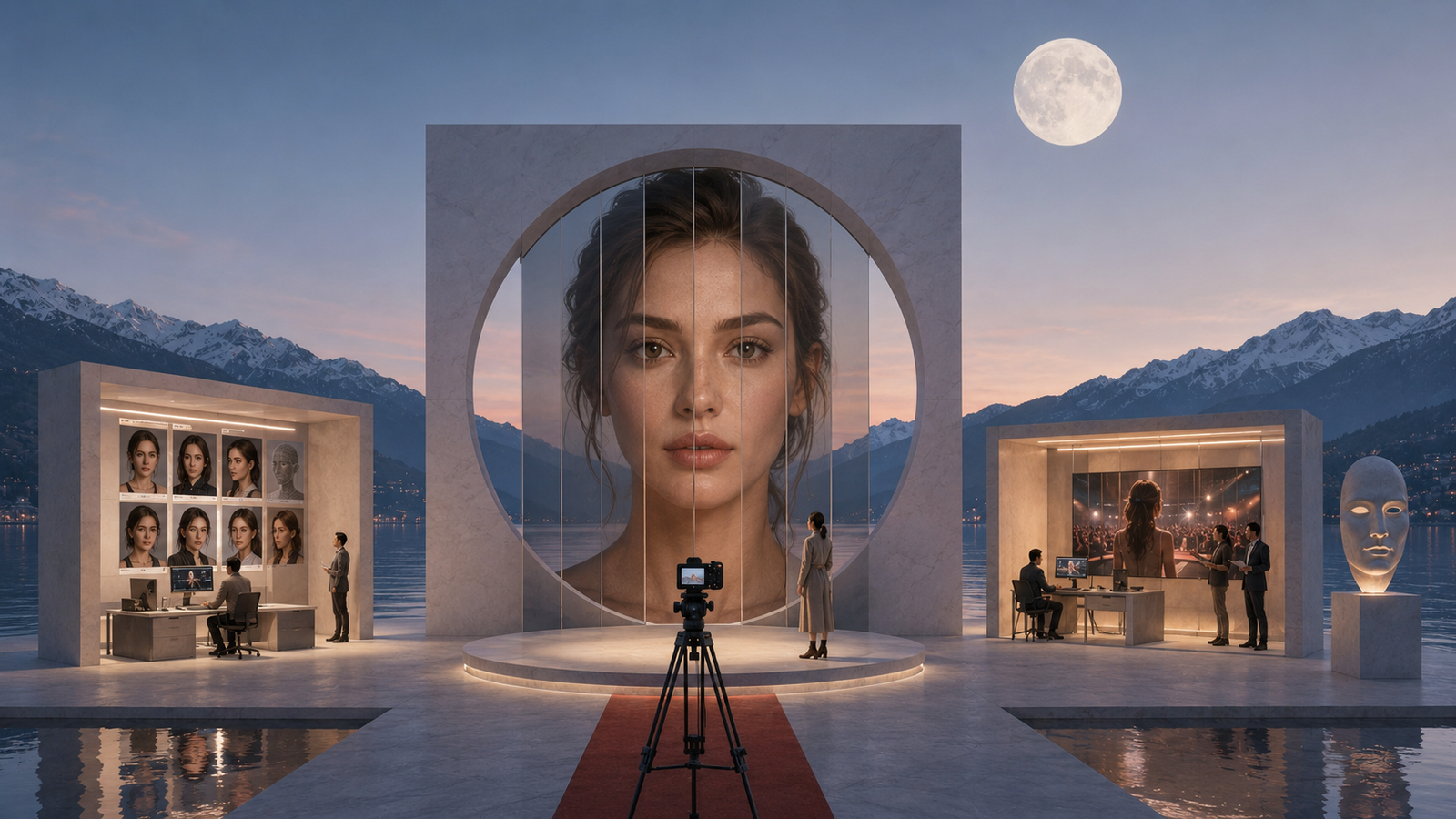
Tilly Norwood is going to star in a film. Normally, that sentence would not require much explanation. Except Tilly Norwood has never been born, never been to an audition and never stood in front of a camera. She is an AI-generated performer created by Particle6, and this summer the company announced that she would appear in Misaligned, a feature film built around her synthetic presence.
What makes the experiment interesting is not simply that an artificial character is appearing in a film. Cinema has been creating imaginary characters for more than a century, and audiences have never needed Mickey Mouse, Barbie or Darth Vader to exist in the physical world in order to care about them. Tilly Norwood represents something slightly different. Her creators are not treating her only as a character inside one story, but as a performer who could theoretically move from one role to another, appear in films, advertising, music videos and other formats, and gradually develop something resembling a career.
That distinction matters because it pushes AI into an area of culture that has traditionally depended on a very specific relationship between fiction and reality. We have always accepted invented characters. What is new is the possibility of inventing the actor behind them.
A celebrity without a life
Celebrity has always involved a degree of fabrication. Hollywood studios were constructing carefully controlled public personas long before Instagram existed, while musicians, actors and athletes have always relied on teams shaping everything from visual identity to interviews, public appearances and personal narratives. Influencers simply industrialised the process by turning everyday life itself into media.
Yet behind all of those constructions there has always been a person, and that person has always remained partly uncontrollable. They age, disappear, change their minds, fall in love with unexpected people, give bad interviews, make terrible career decisions, reinvent themselves, become politically inconvenient or simply stop behaving in the way their audience expects. Much of celebrity culture is built on that tension between the public image and the human being who occasionally escapes it.
A completely synthetic celebrity removes much of that uncertainty. Tilly does not need to sleep, renegotiate a contract or protect her private life. Her age can remain fixed indefinitely. Her appearance can be modified whenever required. She can theoretically be present in several places at once, and her opinions, personality and behaviour can all be adjusted by the people controlling the character.
From a production standpoint, the advantages are obvious. From a cultural standpoint, they are much more ambiguous, because the qualities that make human talent inconvenient are often the same qualities that make people interesting in the first place.
Fame is beginning to separate from the human body
Tilly Norwood is the most obvious version of this shift, but the same logic is beginning to appear around real celebrities. This summer, The View host Sunny Hostin licensed her image and likeness to an AI production company, with the intention of using a synthetic version of herself in adaptations of novels she has written. In this case, AI is not replacing a public figure without permission. The public figure is actively turning her own face and voice into licensable assets.
That may be a more realistic preview of what synthetic celebrity looks like in the short term. We are unlikely to wake up tomorrow in a world where entirely invented stars suddenly replace Beyoncé, Brad Pitt or Zendaya. It is much easier to imagine famous people becoming increasingly detachable from their physical selves. Their voice can be licensed. Their face can be reproduced. Their younger appearance can return. Their gestures can be replicated. They can appear in content they never physically performed.
Hollywood has been moving toward this for years through digital doubles, de-aging and posthumous appearances. Generative AI changes the economics by making those techniques faster, cheaper and available to far more people. Once that happens, the main question is no longer whether we can recreate someone convincingly, but who has the right to operate their likeness and under what conditions.
The celebrity gradually becomes both a person and a library of assets.
The fake Brad Pitt problem is really about scarcity
An AI-generated video showing Brad Pitt fighting Tom Cruise on a rooftop circulated widely this year. The clip was short, but realistic enough to reignite anxiety in Hollywood over just how quickly synthetic video is improving. The obvious issue is one of likeness rights, but there is another cultural consequence that is just as interesting.
For decades, being famous meant controlling access to something scarce: yourself. Film studios negotiated for your presence. Brands paid to associate themselves with you. Magazines competed for interviews. Photographers chased images that could not simply be manufactured on demand.
Generative AI changes that scarcity. Brad Pitt no longer needs to participate in order for a convincing image of Brad Pitt to exist. George Clooney raised a similar concern at the Venice Film Festival this week when discussing the increasing sophistication of deepfakes and the prospect of losing control over his likeness, including after his death.
The legal questions surrounding ownership will be enormous, but there is another question for culture. If a recognisable person can appear endlessly in material they never created, the meaning of that appearance starts to change. Part of the power of celebrity has always come from the fact that seeing someone somewhere implied that they had chosen, or at least agreed, to be there. AI weakens that connection.
Music is already showing us what abundance looks like
Music may be providing the clearest glimpse of what happens when AI removes production constraints almost entirely. Deezer reported this summer that tracks detected as completely AI-generated had passed 50% of all new music uploaded to the platform at their June peak, with around 90,000 AI-generated tracks arriving every day on average.
That does not mean listeners suddenly prefer AI music to human artists. Far from it. But the number itself is revealing because it shows how quickly production can become almost limitless once cost and effort collapse.
AI can already generate enormous amounts of technically competent music. What it has not solved is the question of why anyone should care about a particular song.
Popular music has never existed purely at the level of sound. Amy Winehouse mattered because of her voice, but it would be absurd to separate that voice entirely from the life around it. David Bowie was not culturally important simply because his songs were well composed. Taylor Swift fandom does not exist because millions of people have independently concluded that her chord progressions are objectively superior to everything else available on Spotify.
Biography, mythology, style, relationships, conflict, reinvention and personality all become part of how music is experienced. The music matters, but so does the person producing it and the story audiences attach to that person.
Ninety thousand AI-generated tracks a day therefore creates an interesting paradox. We may soon have more perfectly acceptable music than anyone could possibly listen to, while cultural attention becomes even more concentrated around the relatively small number of artists whose work appears to mean something beyond the file itself.
Influencer culture makes the question even stranger
Influencer culture developed in almost the opposite direction. Traditional celebrity was distant, managed and relatively inaccessible. Social media created value by making public figures appear closer to everyday life. Creators showed bedrooms, meals, relationships, arguments, holidays and bad days, and much of the appeal came from the sense that there was a real person on the other side of the screen.
Of course, that authenticity became increasingly professionalised as the creator economy grew. Content calendars, management companies, production teams and brand contracts gradually replaced much of the spontaneity. Even so, the basic social contract remained intact: the audience believed there was a real person behind the account.
Virtual influencers such as Lil Miquela challenged that assumption years ago. AI now makes it possible to push the idea considerably further. A synthetic personality could publish continuously, respond individually to followers, remember previous conversations and adapt its behaviour based on audience reactions. In theory, it could maintain millions of personalised relationships simultaneously and be more responsive than any human celebrity could ever hope to be.
Would that make the relationship less authentic? Probably. Would it automatically make the relationship less powerful? That is a harder question.
People already form deep emotional attachments to fictional characters while knowing perfectly well that those characters are fictional. Humans do not require something to be physically real before assigning meaning to it. What remains uncertain is whether audiences are willing to accept fictional characters that are designed to occupy the same social category as real people.
Tilly Norwood will be an interesting test of that boundary.
Brands should think carefully about what they actually buy when they buy influence
The consequences for brands go well beyond whether AI-generated influencers should appear in a campaign. Celebrity endorsement has traditionally worked because a person already possesses cultural meaning. The brand borrows part of that meaning through association.
AI makes it possible to reverse the model. Instead of finding a person who already matters culturally, a company could theoretically manufacture the person, construct the audience, design the personality and then connect that character to the brand.
From an operational perspective, it sounds almost perfect. There are no scheduling conflicts, no competing contracts, no unexpected political opinions, no ageing out of a target demographic and no off-brand interviews. Appearance, language, geography, wardrobe and behaviour can all be controlled.
That level of control may also be precisely what makes the result culturally uninteresting.
Cultural relevance rarely emerges from complete control. The musicians, actors, athletes, designers and creators who genuinely reshape culture tend to bring something that organisations could not have designed themselves. Their independence is part of their value. Their behaviour is not always predictable because they exist outside the brand.
If you remove that independence, you may retain the visual language of influence while removing much of what made the influence valuable.
The real distinction may not be human versus AI
There will be a temptation to frame all of this as another argument about whether AI-generated culture is authentic or fake, good or bad, human or synthetic. That distinction is probably too simple to remain useful for very long.
AI will become part of filmmaking. It will become part of music production. Celebrities will license synthetic versions of themselves. Creators will use generative tools so routinely that eventually nobody will bother mentioning them. Some entirely artificial personalities will almost certainly develop genuine audiences.
The more interesting distinction may be between culture that carries meaning and content that merely reproduces the appearance of culture.
That difference already exists without AI. There are perfectly human influencers with enormous audiences who contribute very little culturally, while fictional characters have shaped fashion, language, behaviour and identity for generations. Being human does not automatically make something meaningful, just as being synthetic does not automatically make it meaningless.
What AI changes is the volume of material capable of reproducing the external signs of cultural relevance. It can imitate the look of celebrity, the sound of pop music, the aesthetics of a subculture and increasingly the visual language of cinema. As those signals become easier to manufacture, what exists beneath them becomes more important.
A point of view matters. A history matters. Risk matters. An actual relationship with an audience matters. The possibility of surprise matters. Something has to give people a reason to care beyond the fact that the content looks technically convincing.
The human star may become more valuable precisely because humans are difficult
There is an interesting historical pattern here. Photography did not eliminate painting. Recorded music did not eliminate concerts. Streaming did not eliminate cinemas. In some cases, technological abundance made the more difficult, physical or unrepeatable experience feel more valuable rather than less.
Something similar may happen to celebrity.
The better synthetic performers become, the more certain forms of human presence could gain value precisely because they cannot be perfectly reproduced. A live performance matters because something can go wrong. An artist changing direction matters because nobody completely controls the decision. A creator discussing something they actually experienced carries a different kind of weight. Even something as ordinary as watching a face become older may eventually acquire meaning in a media environment where age can be removed with a prompt.
None of these qualities are efficient. That may become part of their appeal.
Tilly Norwood does not need to become the next major Hollywood star for the experiment to matter. Her existence already tells us something important about where entertainment is heading. We can manufacture the face of a celebrity, reproduce the voice, generate the performance and increasingly manufacture much of the media surrounding the character.
What remains much harder to manufacture is the reason people care.
And pop culture has always depended on that more than anything else.
What this means for brands
For brands, the rise of synthetic culture is not simply another production question. It changes how cultural value is created, how identity can be owned and reproduced, and how audiences decide what feels meaningful. Using AI well will require more than generating better content. It requires knowing when technology adds value, when human presence matters and where cultural judgment cannot simply be automated.
Moon Above Advisory works with leadership and marketing teams on those questions through our AI Brand Transformation offer, helping brands define where AI belongs in the organisation and where human, cultural and strategic judgment should remain central.
Explore AI Brand Transformation →
https://moonaboveadvisory.com/
As production increases, brands also face a much more immediate problem: the number of decisions that have to be reviewed increases with it. More agencies, creators, markets and AI tools mean more opportunities for the brand to drift from one execution to the next.
Signal, the Brand Decision System by Moon Above, is designed to help teams review campaigns, content, creators, partnerships, claims and other brand decisions against the brand strategy before they go live.
Discover Signal →
https://signal.moonaboveadvisory.com/