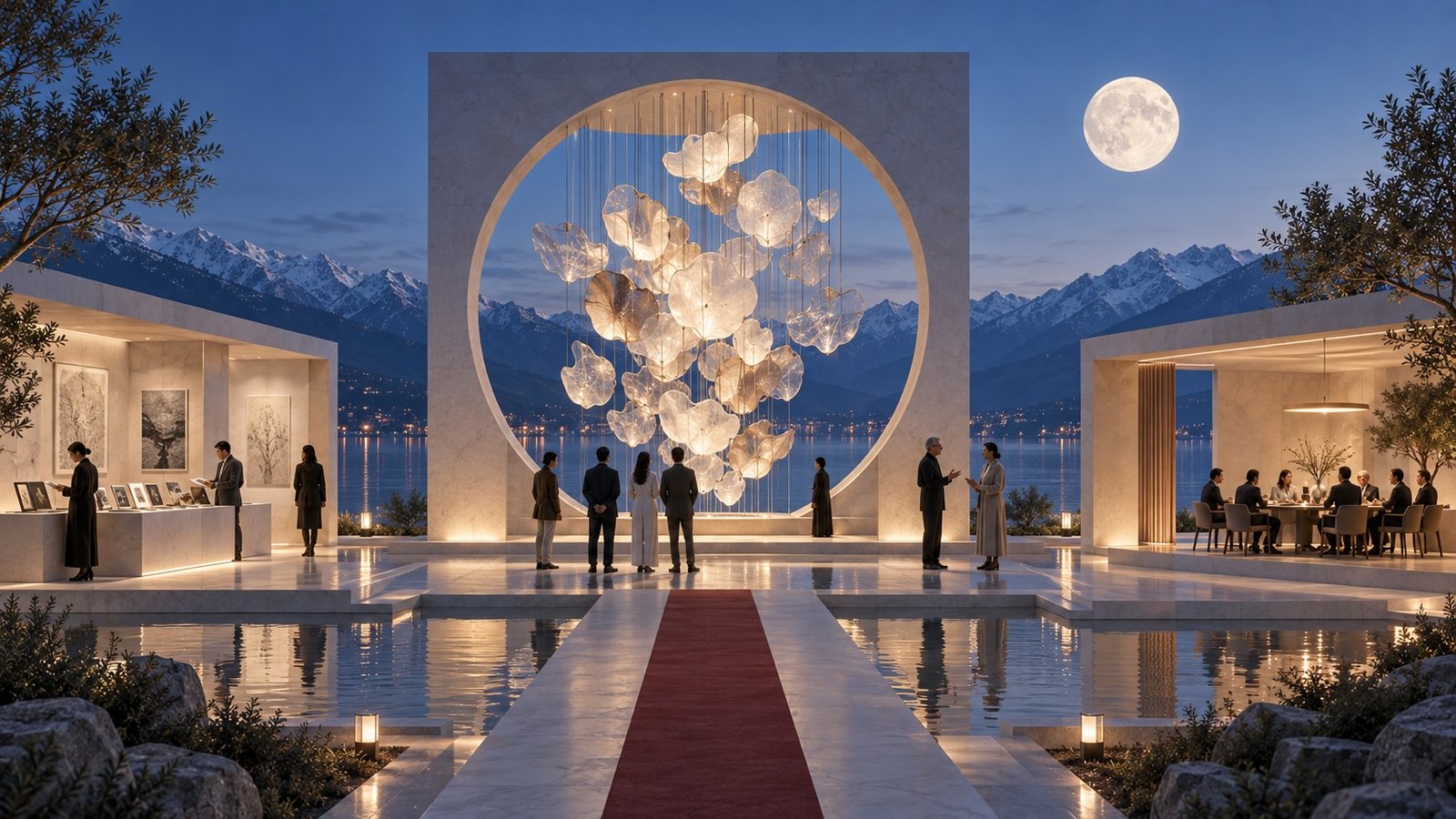
For a few days, they bring together artists, designers, architects, fashion executives, hospitality groups, founders, media and private clients in the same city. That concentration of people and attention is naturally attractive to brands, but presence alone does not create legitimacy.
The difficulty is that art remains a very particular cultural context. A brand can spend heavily around a fair, invite the right people, create a highly visible installation and still feel completely out of place. The issue is rarely execution alone. It usually starts earlier, with a weak answer to a simple question: why should this brand be here at all?
Art is not just another sponsorship category
One of the most common mistakes is to approach an art fair in the same way a brand might approach Formula 1, tennis or a music festival. The logic becomes familiar very quickly: secure visibility, invite clients, create a branded space, generate content and measure exposure. That approach can work in entertainment, where commercial presence is often expected. In art, it is much easier for the same logic to feel intrusive.
Art audiences are particularly sensitive to brands that appear to use culture mainly as a backdrop. The problem is not commercial involvement itself. Brands have supported artists, institutions and collections for decades. The problem appears when there is no clear contribution beyond money and visibility. The better starting point is therefore not “How can we be seen at Art Basel?” but “What can we add here that makes sense coming from us?”
That distinction is fundamental because it changes the role of the brand. Instead of behaving like an advertiser entering a cultural space, the company begins to think like a participant with a defined contribution.
The fair is only one part of the opportunity
Brands also tend to focus too literally on the fair venue itself. In reality, the most interesting opportunities often sit around the fair rather than inside it. During Frieze or Art Basel, the host city becomes temporarily reorganised around art. Galleries open exhibitions, museums extend programming, hotels become informal meeting points, restaurants host private dinners and brands create temporary spaces across different neighbourhoods.
This gives companies much more freedom than they often assume. A hospitality brand does not need a booth to have a relevant role. A fashion house does not need to dominate a venue with logos. A technology company does not need to commission an oversized installation purely for social content. Depending on the brand, it may make more sense to support an exhibition, commission a publication, host a conversation, fund research, organise a dinner with an artist or create a temporary space away from the fair.
The strongest idea is usually not the most visible one. It is the one that feels most specific to the brand.
Start with the brand, not the artist
Many art projects begin with the sentence: “We should collaborate with an artist.” From there, the conversation becomes a search for names. Who is relevant? Who has cultural credibility? Who is already visible? Who has the right audience? This is usually the wrong order.
The brand should first decide what it actually wants to explore. That may be craft, nature, technology, memory, movement, urban life, materials, hospitality or another subject that already has some connection with the business. Only then should the search for an artist begin. The artist becomes the right person to develop a subject, rather than a cultural name attached to a campaign.
Ruinart is a useful example because its work with artists has been developed over time around themes closely connected to the Maison, particularly nature and the environment. For Art Basel Paris 2026, Ruinart is continuing its Conversations with Nature programme with Tadashi Kawamata. The strength of the project does not come simply from the artist’s reputation. It comes from the fact that the commission sits within an existing cultural direction.
That continuity matters. It makes the fair one moment in a broader programme rather than a one-off attempt to borrow cultural legitimacy.
Decide what role the brand wants to play
There are several credible ways for a brand to participate in the art world, and they are not interchangeable. A company can act as a patron, commissioner, collector, host, publisher or facilitator. It can provide funding, space, access, production support, research, travel or distribution. What matters is that the role has some relationship to the brand itself.
Airbnb’s partnership with Art Basel provides a useful example. Its Arts Travel Grant supports travel for emerging artists and galleries. The connection is straightforward: international art fairs depend heavily on mobility, and Airbnb is a travel company. The company is therefore contributing through an area that is directly related to its own business rather than simply attaching its name to an event.
This type of fit is strategically stronger because it is difficult to separate the initiative from the company behind it. The idea would not make exactly the same sense coming from every other sponsor.
If another brand could do exactly the same thing, the concept is probably too generic
This is one of the simplest tests a brand can apply to an art activation. If the logo can be replaced by another company without changing the concept, there is probably not enough connection between the idea and the brand.
A bank, a fashion house, a hotel group and a technology company should not behave in exactly the same way around an art fair. They have different histories, different capabilities and different reasons for entering the conversation. Their programmes should reflect that.
Miu Miu’s presence around Art Basel Paris, for example, makes sense within a broader history of work across film, architecture and cultural programming. Deutsche Bank’s relationship with Frieze sits within decades of collecting and supporting contemporary art. In both cases, the art fair is not the first contact between the company and culture. There is already context behind the participation.
That background gives the brand more room to act because the relationship does not feel invented for the occasion.
The logo should not become the main event
One of the tensions in any art partnership is visibility. If a brand is investing significant money, internal teams naturally want to see a clear commercial return. This can quickly lead to larger logos, more signage and more branded content. Yet in an art context, excessive visibility can weaken the work itself.
A better approach is often to let the artist, curator or idea occupy the foreground while the brand owns the context around it. The association can still be obvious without turning the project into an advertisement. In many cases, restraint strengthens the connection because the audience remembers who supported something they actually valued rather than who occupied the most visual space.
This requires a certain confidence from the brand. Cultural credibility is not always created through maximum exposure. Sometimes it comes from knowing when not to dominate.
VIP hospitality should have a point of view
Art fairs attract exactly the type of audiences many brands want to reach: collectors, founders, executives, creatives and internationally mobile clients. It is therefore unsurprising that dinners, lounges and private events have become standard parts of the brand playbook.
There is nothing wrong with those formats. The problem is that many of them are interchangeable. A private dinner can belong to almost any luxury brand unless there is a specific idea behind it. The format becomes much stronger when it connects directly with an artist, commission or subject.
An artist-hosted dinner, for example, can extend the logic of a project into another medium. A chef and an artist might build a menu around a shared theme. A small conversation can bring together people from art, architecture or science around one precise question. A temporary library or publication can offer something to keep rather than another evening that disappears the next morning.
The objective should not be to make hospitality feel more expensive. It should be to make it more specific.
Do less, but make it worth remembering
Art fairs create pressure to produce too much. A brand arrives in Paris or Miami and suddenly plans an installation, dinner, party, influencer programme, content series, panel and VIP experience at the same time. The result is often expensive but fragmented.
A smaller number of stronger ideas usually creates a better position. One commission can be enough. One artist relationship can be enough. One publication can be enough. One dinner can be enough if the concept behind it is strong.
The relevant question is not how many touchpoints can be created over the week. It is whether there is a central idea strong enough to connect them.
Think beyond the fair week
The brands that are most credible in art usually work over time. A first year can establish a subject. A second can deepen it. A third can introduce a new artist, medium or geography. Over several years, the brand can become associated with a particular type of commission, cultural community or point of view.
This is where art can become especially valuable from a brand perspective. A one-off activation may generate attention, but continuity can create association. The company gradually builds a recognisable position that is not dependent on one campaign or one event.
The fair should therefore be treated as an annual moment within a longer programme rather than the entire programme itself.
Five questions to answer before entering an art fair
Before committing budget to Frieze, Art Basel or any other major fair, a brand should be able to answer five questions with precision: Why art? Why this fair? What subject belongs naturally to the brand? Why this artist, gallery or institution? What are we contributing beyond money and visibility?
If those answers are weak, the project will usually feel weak too. If they are strong, the brand does not need to overstate its presence.
It has a reason to be there.
And in an art context, that reason is often what separates a brand people notice from a brand people respect.
Moon Above Advisory works with brands on cultural positioning, artist partnerships, commissions and art-led brand programmes.
We help define the subject first, then identify the right artists, partners and formats to build around it.